Writeback
Writeback lets a portal page write data back to a database by running a stored SQL statement against a database connection. You define a writeback once in the admin console, then invoke it from a page — for example, to let users submit edits, approvals, or comments that persist to your database.
Note
In the admin console this feature is called Writeback. In the REST API the same object is called a db_modification — keep this in mind when invoking a writeback.
Manage writebacks
Open the admin console and go to Writeback. The list shows each writeback's name, ID, SQL preview, and database connection. Use the row menu to Edit, Duplicate, or Delete a writeback, or click New Writeback to create one.
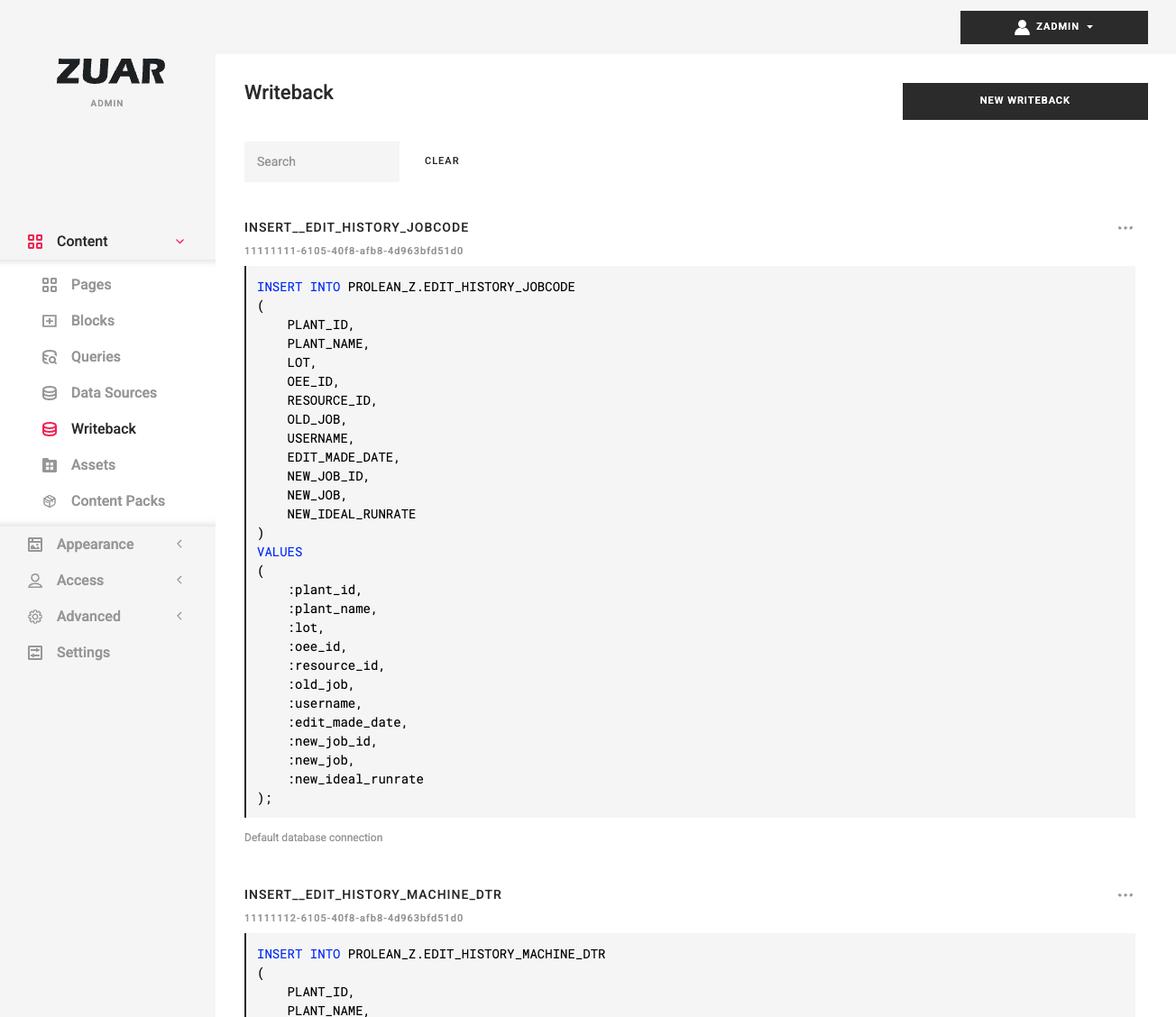
Configure a writeback
Each writeback has the following fields:
- Name — a unique name. You reference this name when invoking the writeback.
- database connection — the database to write to. Choose a stored Database Connection Named Credential, or leave it empty to use the Portal's default database.
- Default Parameters — default values for the named parameters in your SQL. These are merged with the parameters supplied at invocation time, which take precedence.
- SQL — the statement or statements to run. Use named parameters like
:column_a, and end each statement with a semicolon (;).
Name and SQL are required.
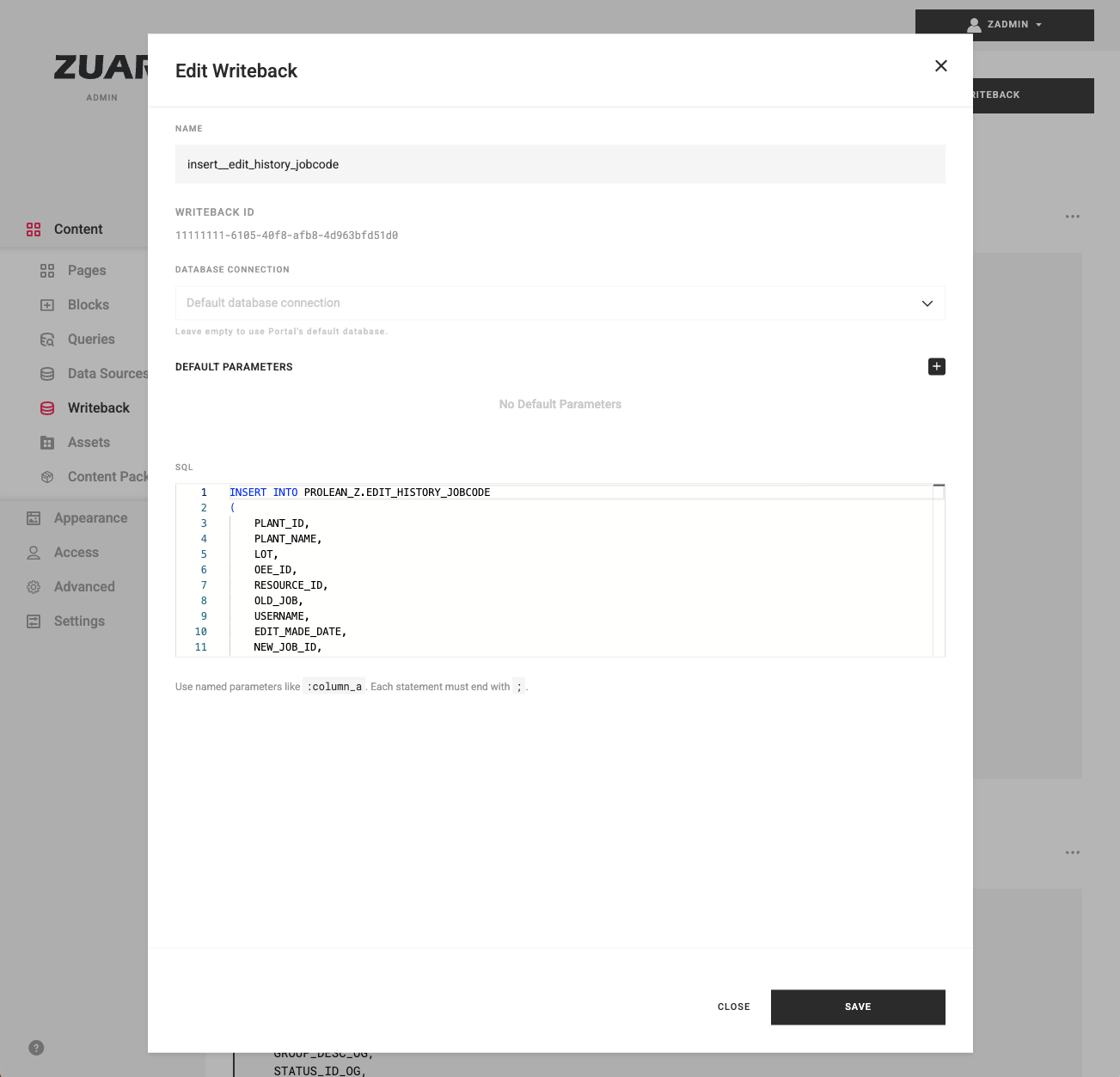
Invoke a writeback from a page
Run a writeback at page runtime by calling the POST /db_modifications/run endpoint — for example, from an HTML block:
await fetch('/api/db_modifications/run', {
  method: 'POST',
  headers: { 'Content-Type': 'application/json' },
  body: JSON.stringify({
    db_modifications: [
      { name: 'my-writeback', params: { column_a: 'value' } }
    ],
    autocommit: false,
    ignore_sql_errors: false
  })
});
- Reference each writeback by its name, and supply values for its named parameters in
params. - To run the same writeback once for each of several parameter sets, use
params_list(an array of parameter objects) instead ofparams. The two are mutually exclusive. autocommitdefaults tofalse, which runs all writebacks sharing a database connection in a single transaction. Set it totrueto commit each statement individually.ignore_sql_errorsdefaults tofalse. Set it totrueto continue past failing statements and capture their errors in the response.
The response returns, for each writeback, a list of results — each with the affected rowcount or an error message.
Note
Confirm the API path prefix (/api) for your deployment. The writeback endpoints are served by the /db_modifications router.
Permissions
Warning
Creating, editing, and deleting writebacks is restricted to administrators. The run endpoint, however, only requires an authenticated user and is not filtered by access groups — any signed-in user who knows a writeback's name can execute it. Design your writebacks, and their SQL, with this in mind.
Writeback SQL runs verbatim, so INSERT, UPDATE, DELETE, and DDL statements are all permitted. Test writebacks carefully before exposing them on a page.